

Most numerology is descriptive. It tells you what kind of person you are, which is interesting for about twenty minutes and then sits there, unchanging, for the rest of your life.
Cycle work is different. It moves. Your Personal Year is not the same this year as last, your Personal Month rolls over twelve times, and your Personal Day changes while you sleep. That movement is what makes the framework usable — and it is the part an app is genuinely better suited to than any other format, because the calculations are repetitive and the value comes from consistency over time.
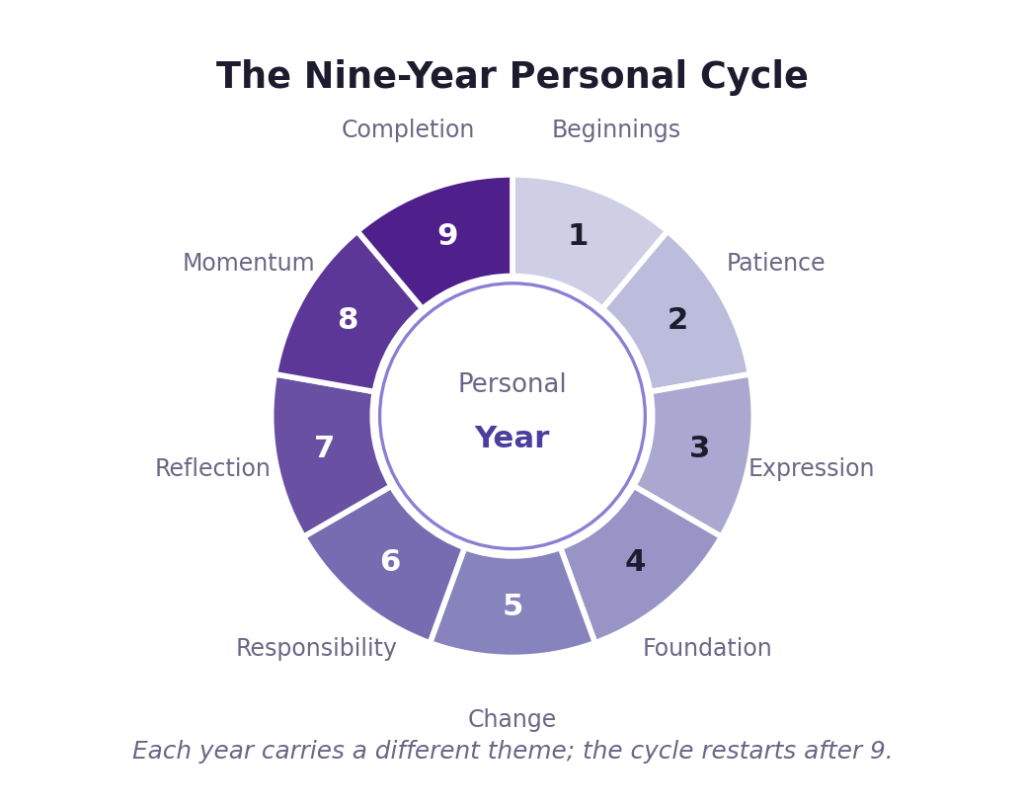
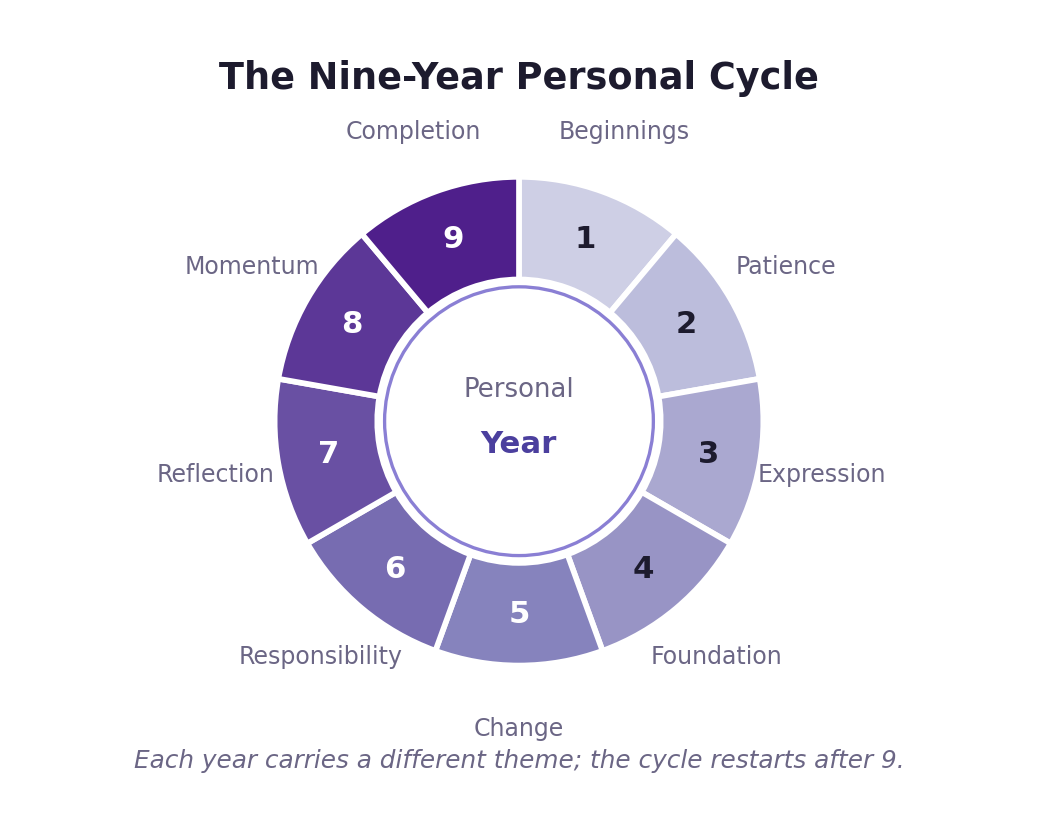
Image: The nine-year personal cycle
How the cycle works
The Personal Year is derived from your birth day and birth month added to the current calendar year, then reduced to a single digit. It runs from 1 to 9 and then restarts, meaning everyone moves through a nine-year cycle offset according to their birth date.
The themes follow the standard numerological progression. One is beginnings — the start of a cycle, when new things planted tend to take. Two is patience, partnership, and consolidation, and is frequently frustrating for people who enjoyed year one. Three is expression, creativity, and visibility. Four is foundation and unglamorous building work. Five is change, movement, and disruption. Six is responsibility, home, and care for others. Seven is reflection and withdrawal, often the quietest year of the nine. Eight is momentum and material results. Nine is completion, release, and clearing the ground before the cycle begins again.
One useful note on convention: traditions differ on whether the Personal Year turns over on 1 January or on your birthday. Apps differ too, and most do not say which they use. It is worth finding out, because a six-month discrepancy makes the whole exercise unfalsifiable.
Why an app is the right tool for this specific job
The static numbers in your chart need calculating once. Cycles need calculating continuously, and the value of cycle work comes almost entirely from repetition.
Reading your Personal Year once, in January, is a novelty. Recording what it predicted, checking it in June, and reading it back in December is an actual experiment. Doing that across three or four years produces something genuinely worth having: evidence, from your own life, about whether the framework describes anything real.
That is a record-keeping problem, and record-keeping is what software is for. When evaluating a Best Numerology app shortlist, cycle coverage is the feature I would weight most heavily — an app that reports only your static chart has a useful life of about one week.
Using the cycle without becoming superstitious about it
There is a bad version of cycle work where a person refuses to start anything in a Personal Year 9 and treats a Personal Day 4 as a reason to cancel plans. That is not timing; that is outsourcing your judgement to arithmetic.
A better framing: treat the cycle as a question rather than an instruction.
In a Personal Year 1, the question is what you are actually starting, and whether you have chosen it deliberately or are simply drifting into whatever presents itself.
In a Personal Year 5, the question is whether the change you are in is a direction or an escape — five is the digit of movement, and movement without direction is just churn.
In a Personal Year 7, the question is whether you can tolerate a quiet year without manufacturing a crisis to make it feel productive. Seven years are frequently misread as stagnation by people who have not yet learned to sit still.
In a Personal Year 9, the question is what you are still carrying that belongs to the cycle that is ending.
None of these tell you what to do. All of them are better questions than most people ask themselves unprompted, and that is the honest case for the practice.
Personal Months and Days
The shorter cycles work the same way at smaller scale — the Personal Month adds the calendar month to your Personal Year, and the Personal Day adds the date.
My honest read is that the Personal Day is where most people overreach. Nine themes distributed across every day of your life will match your actual experience roughly as often as chance, and treating it as guidance for individual decisions produces the superstition problem above.
The Personal Month is more defensible. A month is long enough to have a texture, short enough to remember accurately, and it is a reasonable unit for the kind of loose planning the framework supports — knowing that a 4 month is better spent on unglamorous groundwork than on a launch, for instance.
Making it a practice rather than a habit of checking
Three things make cycle work worth the time.
Write the prediction down before the period starts. At the beginning of the year or month, note what the theme is and what you expect. Predictions recorded afterwards are worthless, because memory reshapes itself around whatever happened.
Review on a fixed date. End of the month, end of the year. Fifteen minutes. Ask what actually happened and whether the theme described it.
Be willing to record misses. This is the part that separates a practice from a comfort. If a Personal Year 8 was financially flat, write that down. A record that only contains hits is not a record.
Platforms such as Raka numerology that keep your cycle history make this considerably easier than recalculating by hand each time, though a notebook works perfectly well if you are disciplined about it.
The point
Cycles turn numerology from a personality description into something you can actually test. The nine-year structure gives you a framework for asking better questions about timing, and an app gives you the record that lets you find out, over a few years, whether the framework is telling you anything.
Either answer is worth having. What is not worth having is checking the number every morning and never once writing down whether it was right.