
Here’s a claim most founder-advice content won’t make: the anxiety you’re feeling about your business right now might not be telling you anything about your business at all. It might just be telling you that your nervous system has been in a stress response for long enough that it’s started narrowing your decisions for you. That’s a different problem than the one most business-stress content is written to solve, and it needs a different starting point.
Why The Standard Advice Gets The Order Backwards
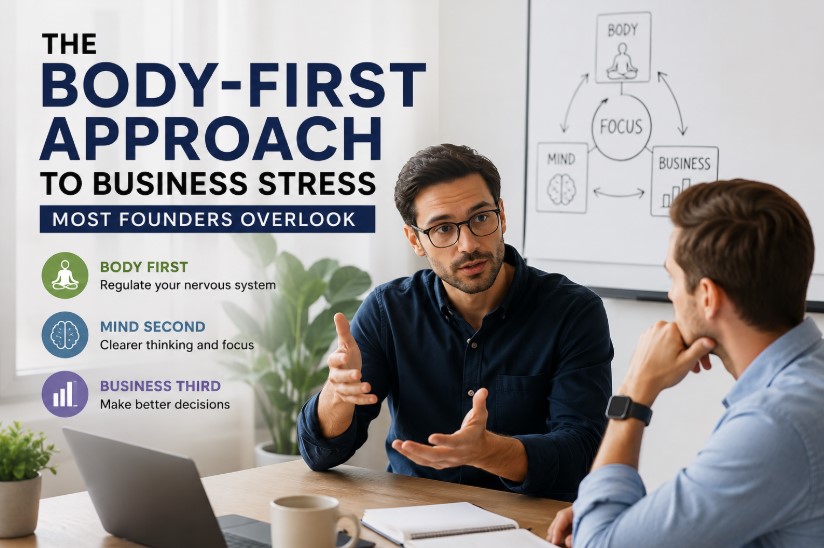
Most guidance on business stress starts with the business — better systems, clearer boundaries, delegation. All useful, all built on an assumption that rarely gets stated out loud: that the person implementing them has a nervous system regulated enough to actually follow through. Founders under chronic stress don’t fail to delegate because they haven’t read enough about delegation. They fail because a stressed nervous system defaults to control, not trust, and no framework fixes that by itself. The order that actually works is body first, mind second, business third — not the reverse, and not simultaneous.
This isn’t a small distinction. A founder who tries to implement better boundaries while their body is still running a stress response usually holds the boundary for a week, then abandons it the first time something urgent comes up — not from lack of commitment, but because willpower was never the limiting factor. The nervous system was.
The Distinction That Changes What You Do Next
Founders who are anxious about their business tend to treat all of it as the same signal: something is wrong, fix it. In practice there are two distinct kinds of anxiety hiding inside that feeling, and they call for opposite responses. Growth-edge anxiety shows up right before a step that matters — pricing higher, publishing something exposing, having the hard conversation — and it settles once you act on it. Misalignment anxiety keeps returning no matter how many honest attempts you make, because the direction itself isn’t right, not because you haven’t tried hard enough. Most advice treats both the same way, usually by telling you to push through. Pushing through misalignment anxiety doesn’t resolve it; it just delays the point where you finally listen to it.
What This Looks Like In Practice
The mechanism is straightforward, even if it’s rarely applied. Movement — five to ten minutes, nothing elaborate — increases BDNF and measurably improves the prefrontal cortex’s role in impulse control, which is the exact function that governs whether you stay in a hard decision or take the impulse to avoid it. Breathwork works directly on the vagus nerve, bringing cortisol down faster than trying to reason your way calm. And replacing a five-item task list with a single honest intention removes a surprising amount of the decision fatigue founders mistake for overwhelm. None of this is a wellness add-on to the real work. It’s the prerequisite for doing the real work with a brain that’s actually available to do it.
Synchrologic works specifically at this layer — built by someone who spent years running a six-figure marketing agency and working with 500-plus companies, and who formalized this body-first method after seeing how often “business strategy” problems were actually nervous-system problems wearing a business costume. Their work on mental clarity covers this same narrowing effect from a different angle, and the broader case for how body mind connect shows up in everyday business decisions is worth exploring beyond this piece.
Most founders trying to solve business stress are optimizing the wrong layer. The strategy isn’t the problem. The body running the strategy is where it actually starts.